Something shifted in early February 2026. Not because the technology suddenly leapt forward, but because public understanding caught up with what had already been built.
For three years, most people understood AI through a chatbot interface. You typed a question. It responded. The interaction felt bounded and reactive. The system waited for you. It did not initiate actions, access your files, or execute workflows independently.
That mental model is now obsolete.
AI systems are increasingly designed not just to respond, but to act. The distinction is structural. A chatbot generates output. An agent executes tasks.
That difference is the foundation of what changed in February.
Table of contents
From Interface to Infrastructure
The viral spread of OpenClaw, an open-source AI agent, made this shift visible. Unlike a chatbot, OpenClaw could connect to local systems, messaging platforms, and web services. Users could assign a goal, organize my inbox, build a working application, research and summarize a topic, and the agent would determine the sequence of actions required to achieve it.
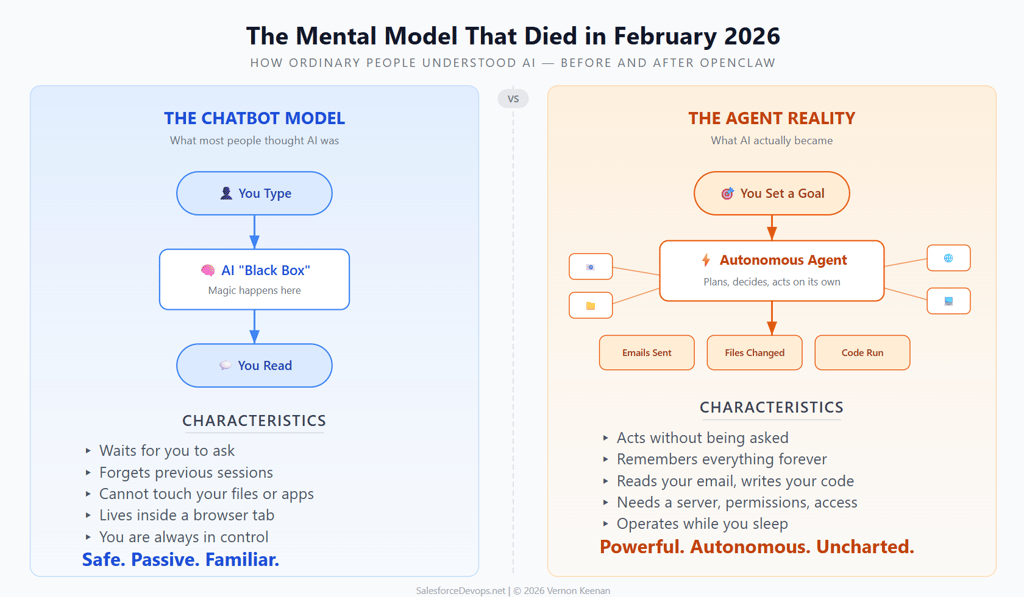
This was not a breakthrough in model intelligence. It was a breakthrough in integration. The language model was embedded inside a loop that could call tools, store memory, and execute commands.
For enterprise technologists, this pattern has been developing for over a year. Major platforms have already deployed agent frameworks capable of interacting with business systems under defined constraints. What February demonstrated was not new capability, but new visibility.
The public encountered, perhaps for the first time, the reality that AI can function as a digital worker.
The shift from “assistant” to “operator” is not semantic. It is architectural.
Capability Without Control
The second development followed quickly. As adoption surged, so did security failures. Poorly configured agents exposed credentials. Some instances were publicly accessible. Researchers demonstrated how agents with broad permissions could be manipulated through malicious prompts or web content.
These incidents did not prove that AI is uniquely dangerous. They proved something more specific: autonomous systems require governance layers proportional to their access.
An agent system consists of at least two parts. The model provides reasoning and language capability. The orchestration layer defines what the system is allowed to do, when it must ask for approval, how it logs actions, and how it can be monitored.
Without that layer, an agent is effectively running with root access.
Enterprise vendors that invested early in deterministic rules, audit trails, and human-in-the-loop checkpoints were sometimes criticized for limiting autonomy. February reframed those constraints as infrastructure. The difference between a demonstration and a deployable system is not intelligence. It is control.
OpenClaw exposed this distinction at scale.
The Labor Signal
At the same time, labor market anxiety intensified. Entry-level knowledge work roles have been contracting. Whether every reduction is directly caused by AI is debatable. Macroeconomic tightening and cost discipline are also factors. But perception has moved faster than proof.
Surveys show rising concern among workers about displacement. Hiring data suggests a slowdown in junior professional roles across several sectors. Even when companies do not explicitly attribute staffing changes to AI, the association is now widely assumed.
This matters because technological disruption is mediated through expectations. If workers believe their skills are depreciating rapidly, they adjust behavior—by delaying career commitments, shifting fields, or demanding regulatory intervention.
The February moment was therefore not just about agents. It was about the convergence of two realizations: that AI systems can act autonomously, and that entry-level knowledge work feels less secure than it did two years ago.
Those realizations reinforced each other.
The End of the Chatbot as the Center of Gravity
It would be inaccurate to say chatbots are disappearing. They are becoming interface layers. The conversational window is increasingly a control surface for systems that execute multi-step workflows behind the scenes.
The center of gravity is shifting from prompt quality to system design.
In an agentic environment, the strategic questions change:
- What tools does the agent have access to?
- What permissions constrain those tools?
- How are actions logged and reviewed?
- When does a human intervene?
These are architectural questions, not conversational ones.
Organizations still organizing their AI strategy around training employees to write better prompts are preparing for the previous phase of adoption. The next phase depends on governance, observability, and integration.
What February Actually Changed
February 2026 did not produce a sudden leap in model capability. It produced public clarity.
The awareness gap between what AI systems could do and what most people believed they could do narrowed abruptly. That shift has consequences.
When awareness rises, so does scrutiny. Policy conversations accelerate. Workers reassess career paths. Investors recalibrate expectations. Companies that lack control frameworks face higher reputational risk.
The critical variable now is not raw intelligence. It is whether institutions build the surrounding systems—technical and social—that make autonomous AI stable and accountable.
Agents will continue to improve. That trajectory is not controversial. The more consequential question is whether governance scales at the same pace as capability.
February did not mark the end of AI experimentation. It marked the end of widespread misunderstanding about what AI systems are becoming.
The chatbot was a preview. The agent is infrastructure. And infrastructure demands rules.
Vernon Keenan is CEO of Keenan Vision LLC and publisher of SalesforceDevops.net. He advises executive leadership on AI strategy and conducts AI transformation research with UC Berkeley Haas School of Business.